Home › Road, Street, and Municipal Paving
Partner with an experienced contractor for road paving in Kansas City, MO. We construct and resurface streets, subdivisions, and municipal asphalt projects. Our team manages grading, base, asphalt placement, and traffic control for safe, long lasting roads. Contact us to bid your next city street or public paving project.
Precision Asphalt Kansas City provides professional road paving throughout Kansas City, MO, Missouri and the surrounding area. Our licensed, insured crew delivers safe, clean, on-time work with a free estimate before anything begins. Call (816) 326-1167 or request your free quote.
Road, Street, and Municipal Paving for Kansas City Communities
Precision Asphalt Kansas City focuses on one thing for road, street, and municipal paving in Kansas City, Missouri: building surfaces that survive heavy traffic, Midwest freeze-thaw cycles, and utility work without falling apart after a few seasons. We work primarily with cities, public works departments, HOAs, school districts, business parks, and private road owners across the metro.
Our crews handle full street reconstruction, mill and overlay projects, new road construction in subdivisions, and repairs to heavily traveled routes near shopping centers and industrial areas. We understand how traffic patterns on I-70, I-435, and neighborhood collectors feed into your streets, and we design paving sections to match the real-world load they carry.
Whether you manage a cul-de-sac in Raytown, a through street in Waldo, or a private drive off 152, we look at how the road is used, what the subgrade is doing, how drainage works, and where past failures have occurred before we recommend a solution. The goal is to spend your budget once, not patch the same spots every year.
How Road Paving Projects Are Planned in Kansas City
Successful road paving in Kansas City starts long before the first load of asphalt arrives. Our process begins with an on-site assessment that focuses on four main factors: subgrade stability, drainage, traffic loading, and existing pavement condition.
We core or test the existing pavement where needed, especially on older streets inside the city where multiple generations of patches may be hiding weak base layers. In areas with clay soils or known groundwater issues, such as parts of Northland and eastern Jackson County, we pay close attention to pumping, rutting, and soft spots that show the base is failing.
Next, we evaluate drainage. Standing water near curbs on residential streets in Brookside or along commercial corridors like Troost often signals clogged inlets, poor cross slope, or low sections of pavement. Because water is one of the biggest threats to Kansas City asphalt, we design slopes, gutter transitions, and in some cases underdrain systems to move water off and away from the roadway.
We then match pavement thickness and structure to traffic demands. A quiet HOA loop might receive a light-duty section, while a route that routinely sees trash trucks, school buses, or delivery traffic needs a stronger, thicker design. By tailoring each segment instead of using a one-size-fits-all section, Precision Asphalt Kansas City helps municipalities and property managers stretch limited budgets further.
Step-by-Step: What Happens During a Road Paving Project
If you have never overseen a road paving project, it can be disruptive if not managed carefully. We walk Kansas City clients through a clear sequence so residents, businesses, and emergency services can plan around the work.
1. Field layout and traffic control: We mark limits of work, utility covers, drainage structures, and tie-in points. Then we set up signage, cones, and detours following local traffic control standards so drivers know what to expect.
2. Milling or removal: For overlays, we use cold milling machines to remove a set depth of existing asphalt. This provides a clean, level surface and maintains curb reveal. For full reconstructions, we remove all pavement and sometimes part of the base if it is contaminated or pumping.
3. Subgrade and base preparation: We proof-roll the exposed base with a loaded truck or roller. Soft spots are excavated and replaced with compacted aggregate. In clay-heavy areas around Kansas City, we often add additional base rock or stabilization to prevent future movement.
4. Tack coat application: Before new asphalt is placed, a tack coat is sprayed to bond layers together. Proper bonding prevents slippage, shoving at intersections, and early cracking.
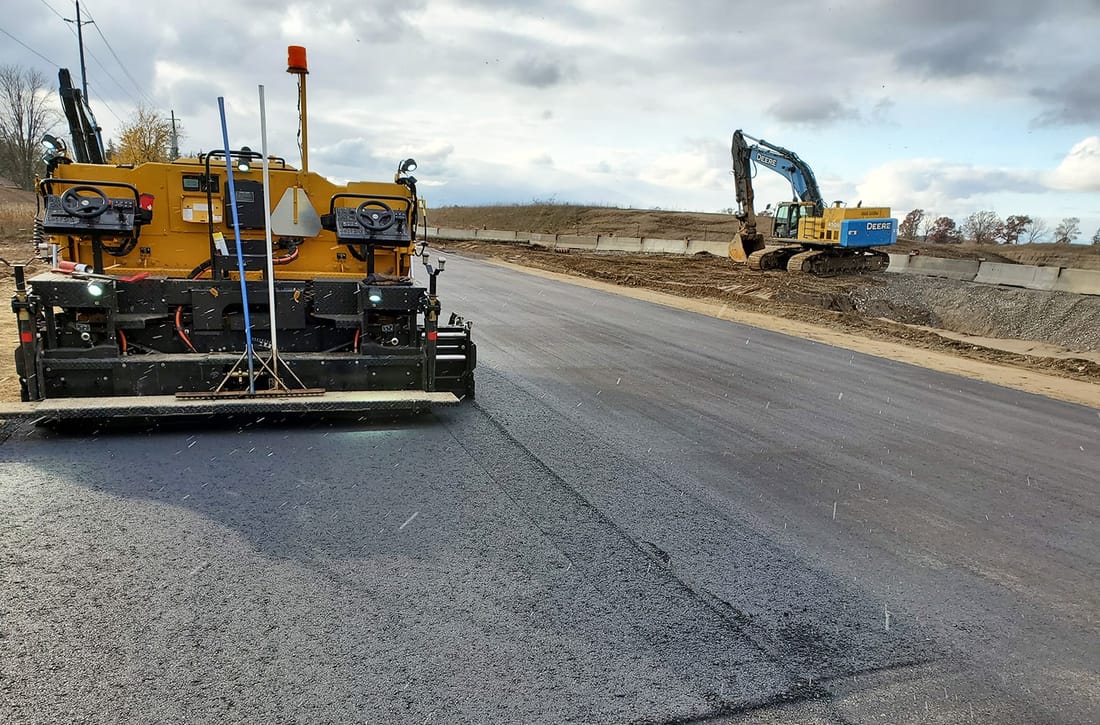
5. Asphalt paving and compaction: Mix is delivered from local plants at controlled temperatures, then laid with a paver to the specified thickness and slope. Rollers follow closely to achieve density targets that improve lifespan and resistance to moisture. For municipal projects, we typically test densities to verify specs are met.
6. Joints, utilities, and tie-ins: Longitudinal and transverse joints are carefully matched and rolled to avoid bumps where lanes meet. Manholes, valve boxes, and inlets are adjusted and neatly paved around. We make sure transitions at driveways and intersecting streets are smooth and safe.
7. Final sweeping, striping, and opening: Once cooled and inspected, the roadway is swept, then lane markings, crosswalks, and symbols are installed. We coordinate phased openings with city staff or property managers to restore access as quickly as possible.
Material Choices and Design Options for Streets and Municipal Roads
Not every Kansas City road needs the same asphalt mix or depth. Precision Asphalt Kansas City works with local suppliers and engineering standards to choose materials that fit your project and budget.
For typical neighborhood streets, we often install a multi-lift asphalt section: a stronger base course at the bottom for structure, then a finer surface course for smoothness and appearance. Collector roads, bus routes, and streets that serve freight or industrial facilities may need thicker sections with high-stability mixes that resist rutting under slow, heavy loads.
Intersections, stop-and-go bus stops, and steep grades sometimes require specialized mixes or thicker asphalt to withstand turning and braking forces. In areas that frequently see utility cuts, such as older neighborhoods south of downtown, we may recommend slightly thicker surfaces that better tolerate future patches.
We also look at whether a mill and overlay, full-depth reclamation, or full reconstruction makes the most sense. Mill and overlay is cost-effective for surfaces with minor cracking but a sound base. Full-depth reclamation mixes existing pavement and base in place, then caps it with new asphalt, which can be ideal for long rural or semi-rural roads with widespread base issues. Full reconstruction is reserved for streets with severe base failure or major grade and drainage corrections.
Striping and safety features are part of the design conversation too. We help cities and HOAs think through crosswalk placement, bike lane markings, reflective thermoplastic versus paint, and raised or recessed pavement markers where appropriate.
What Drives the Cost of Road Paving in Kansas City
Many public works directors and HOA boards ask why two streets of similar length can have very different paving costs. The main drivers are thickness, base condition, access, and phasing.
Thickness and structure: More asphalt and more base rock means more material and hauling. A street designed for garbage truck traffic five days a week will be more expensive than a light-duty cul-de-sac, even if both are the same length and width.
Base repairs: If proof-rolling reveals extensive soft areas, we must dig out and replace or stabilize those sections. Streets built decades ago on poorly compacted fill or with inadequate drainage often fall into this category around Kansas City, especially near creeks or low-lying ground.
Drainage and grade work: Adjusting cross slopes, rebuilding curb and gutter, or installing underdrains adds cost but often saves money long term by keeping water out of the pavement structure.
Traffic control and staging: Busy roads that must remain partially open, streets serving schools with limited scheduling windows, and commercial corridors that require night work all increase labor and traffic control costs. Quiet HOA streets paved in a single closure window are less expensive on a per-foot basis.
Mobilization and project size: Spreading fixed costs, like moving equipment in and out or setting up temporary traffic control, over more square yards brings the unit price down. Small patch jobs or single short streets often cost more per yard than larger coordinated projects.
Common Road Problems in Kansas City and How We Address Them
Our crews work on streets across Kansas City every year, so we see recurring issues tied to our specific climate and soil conditions. Understanding these patterns helps us fix root causes instead of just the surface.
Alligator cracking and potholes: This usually signals base failure, not just old asphalt. We cut out failed panels, repair the base, and then patch with hot mix. For widespread failures, we plan sectional reconstruction or full-depth reclamation instead of endless patching.
Rutting and shoving at intersections: These are common on bus routes and truck-heavy intersections. They typically come from mixes that are too soft for the loading, lack of density, or a weak base. Our solution combines a stiffer mix design, proper compaction, and, if needed, increased thickness in wheel paths or turn lanes.
Edge cracking and shoulder failures: On rural or semi-rural roads, vehicles driving off the edge cause cracking and drop-offs. We often widen asphalt slightly, reinforce edges, and improve shoulders so the pavement is not constantly broken by traffic.
Freeze-thaw damage and heaving: In Kansas City, repeated winter freeze-thaw cycles and trapped moisture cause lifting or settling of small pavement sections. We improve drainage, address trapped water, and in some cases add underdrain systems or more free-draining base materials to keep the structure drier.
Reflective cracks over utility trenches: Older trench repairs can telegraph cracks through new overlays. We may install reinforcing grids, saw and seal joints over known trench lines, or modify overlay thickness to minimize reflection.
Working With Precision Asphalt Kansas City on Your Next Paving Project
Whether you manage a municipal network, sit on an HOA board, or oversee facilities for a school or commercial property, you need a paving contractor who understands the realities of building and maintaining roads in Kansas City, Missouri.
Precision Asphalt Kansas City helps with planning, budgeting, and communication, not just the paving work itself. We can walk your streets with you, prioritize sections by condition and risk, and phase work over multiple years if your budget requires a staged approach.
During construction, we coordinate with city staff, fire and police, trash services, school transportation, and nearby businesses to minimize disruption. For HOAs and private streets, we provide clear schedules and resident notices so people know when to move vehicles and how to access their homes.
We are local, so when winter plows hit new surfaces, or a hard summer storm reveals a drainage concern, you are not dealing with an out-of-town contractor. You have a Kansas City team that knows your roads, your soil conditions, and your traffic patterns, and can respond quickly.
If you are planning road paving or street improvements anywhere in the Kansas City metro, we are glad to review your existing pavement, discuss design options, and prepare a straightforward proposal so you can make an informed decision.